Harpoon Micro-Benchmarks
Welcome to our favorite batch of basic tests assessing your overall health. This is a series of micro-benchmarks — simple, low-skill tests — that give us an objective snapshot of your fitness right now.
Most people have no idea if they're getting fitter. You show up, you work hard, you feel like you're improving — but without a measuring stick, it's hard to know.
Too many people rely on weight loss or one-rep maxes as the only metrics.
These micro-benchmark tests give us more than that.
You can test them at home and see how you can compare to members who have been at Harpoon.
Match them to your age demographic and see what’s possible.
Test them again quarterly, and see how you compare to your past self.
The data tells a story that the scale, mirror, and leaderboard can't.
How will you stack up?
Test 1: Push-Ups
Max reps in 1 minute
Upper body pressing strength. You probably think you know how many push-ups you can do. You might be surprised.
Prescribed:
Start in a tall plank position on your hands, with elbows locked out and your body in a straight line
Lower your chest to the floor on every rep
Lock out elbow and squeeze your quads at the top
Modified:
Same test, same standard — knees down instead of toes
Hands stay exactly where they were
Every other standard applies
What it tells us: Whether your upper body can handle the demands of an active life — paddling, pushing, pressing, getting back up off the ground. It's also one of the first things that quietly disappears when you're not training it, and it certainly causes more neck and shoulder aches when not strengthened appropriately.
Test 2: Plank Hold
Max time
Core stability. This one looks simple until you're forty seconds in and your whole body is shaking.
Prescribed:
Top of push-up position (not on elbows) — shoulders stacked over fully extended elbows, in-line with wrists
Hips in line with shoulders — no sagging, no piking
Quads squeezed, toes tucked and pressing into the floor
Hold until you bend your elbows, drop to knees or pike upward
What it tells us: How well your midline holds up under load. A strong plank means a stable spine — on a heavy deadlift, on a loaded pack, on a long paddle. It's the foundation everything else is built on. With out it, our back screams and carrying heavy things become a burden.
Test 3: Burpees
Max reps in 1 minute
Full body conditioning. Getting on and off the floor — fast — turns out to be a pretty good measure of where your fitness actually is and how your heart reacts to fast effort.
Prescribed:
Get to the ground as fast as you can
Touch the chest to the floor on every rep
Small hop at the top — enough to slide a credit card under your toes
Clap overhead at the top of every rep
Step up or jump up — either counts, your call
What it tells us: Your body's ability to move through a full range of motion under fatigue. It's coordination, conditioning, and grit rolled into one. If the mountains, the water, or the trail ever puts you on the ground, this is the test that tells us how well you get back up.
Test 4: Wall Sit
Max time
Leg endurance and mental toughness. The position looks easy. Holding it is another story.
Prescribed:
Sit in an invisible chair against a wall
Back flat against the wall, shoulders pressed back
Knees directly over ankles, hips at or below knee height
Space between the knees — no caving inward
Arms hanging at sides, extended, or crossed at chest — hands may not touch your knees or thighs
Modified:
Need to rest your hands on your knees or thighs? The clock stops there. Reset and keep going if you can — but that's the standard.
What it tells us: How your legs hold up under sustained load. The same muscles that carry you up a long climb, keep your knees stable on a ski run, or power you through the last mile — this is the test that shows whether they're strong enough to last.
Test 5: Sit to Stand
Max reps in 1 minute
Mobility and longevity. This one isn't about fitness. It's about whether your body still does what bodies are supposed to do.
Prescribed:
Start seated on the floor — legs crossed or feet in close, your choice
Stand up without using your hands or allowing knees to make contact with the ground
Return to the floor under control — same rule applies on the way down
Need more momentum? Lean back slightly and use your hip mobility to drive through — still no hands
Every rep counts, regardless of which variation you use
Modified:
Can't get up without support? Drop one knee and lunge your way up
What it tells us: Your ability to get up off the ground without assistance is one of the strongest predictors of long-term health and longevity. Researchers have tracked it for years. The mobility in your hips and knees assist you or inhibit you. It's not a party trick — it's a window into how your hips, knees, and core are actually holding up.
Test 6: KB Farmer’s Hold
Max time — Men: 2×70lb / Women: 2×53lb
Grip strength. It's one of the most reliable indicators of overall health we have — and one of the first things people stop training.
Prescribed:
Deadlift the bells to standing — chest tall, shoulder blades pinched together
Hold for max time — kettlebell position (front, center, back) doesn't matter
Walk around if you want to, or stay planted — your call
What it tells us: Shoulder, back and core strength and quite simply, how long you can hold on. That sounds simple, but grip strength predicts everything from injury resilience to long-term health outcomes. Whether you're hauling gear, holding a paddle, or carrying groceries up a long driveway — this is the test that tells us your grip is still in the game.
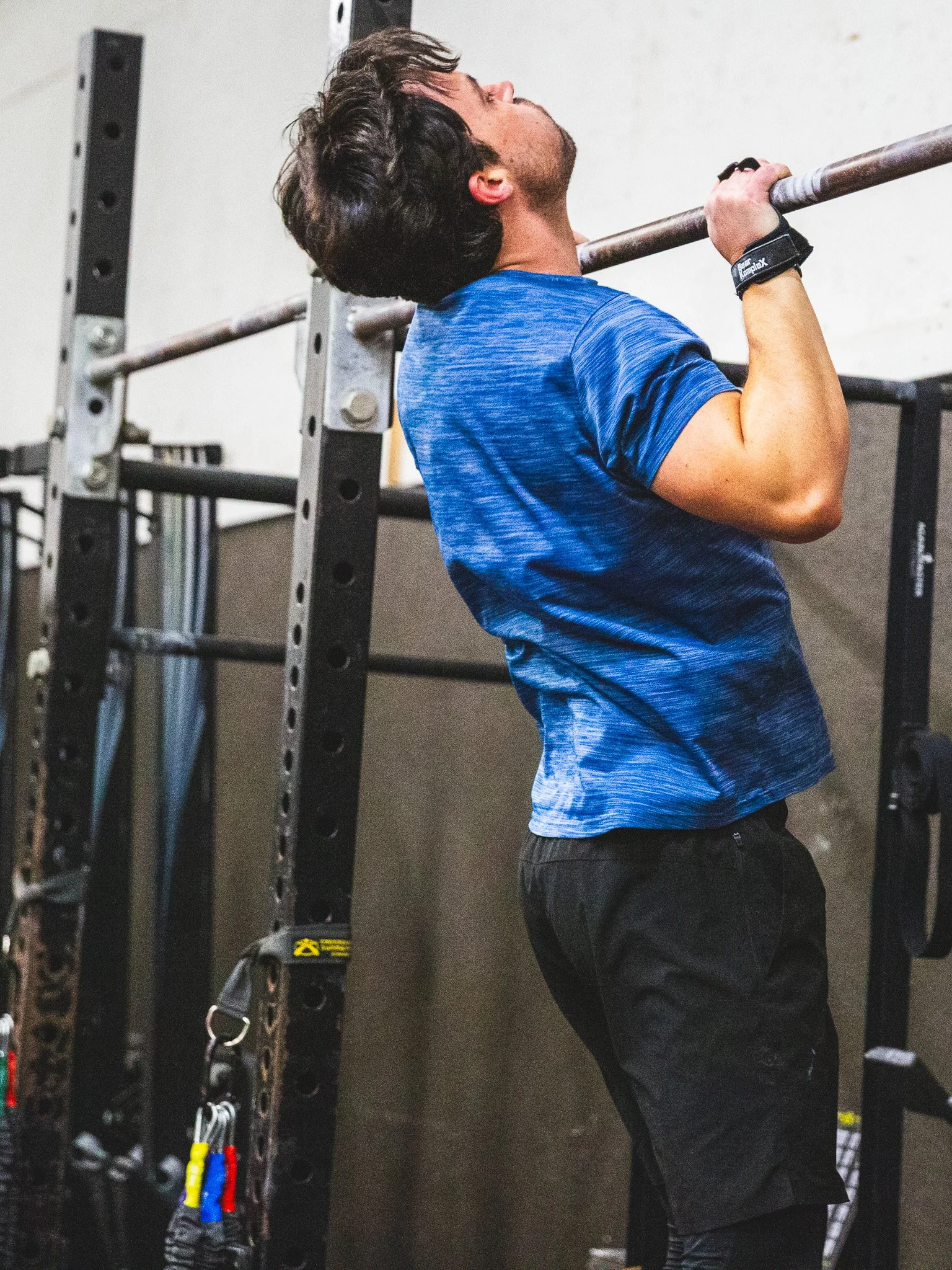
Test 7: Pull-Ups
Max reps in 1 minute
Pulling strength. The ability to move your own bodyweight vertically is a surprisingly honest measure of where your fitness actually stands.
Prescribed:
Jump to the bar and find a full hang — elbows locked out, shoulders active
Body hollow — toes together, core tight
Pull your chin higher than the height of the bar, return to full elbow extension on every rep
No kipping, no momentum
Modified:
Can't string pull-ups together yet? Test your dead hang instead — same hollow position, same active shoulders, max time
This is its own benchmark, not a consolation prize
What it tells us: Your ability to pull your own bodyweight is one of the clearest signals of functional upper body strength. It shows up on the climbing wall, in the water, hauling yourself onto a dock or over a ledge. If you can't do it yet, the hang tells us exactly where to start.
Test 8: 500m Row
For time
The engine test. Five hundred meters doesn't sound like much until you're two hundred in and your lungs and legs are making decisions your ego didn't approve.
Prescribed:
Set the damper to 4 or 5 — this isn't a strength test, it's a conditioning test
Put your butt in the middle of the seat, not the very back
Place your hands on the outer most edge of the paddles, pinkies dangling
Drive sequence: legs first, then hips, then arms — same on the way back
Catch position: shins vertical, arms extended, slight forward lean
Finish: legs flat, slight layback, handle drawn to the lower chest
Go hard from the start — this distance rewards commitment, not pacing
What it tells us: Raw aerobic capacity and how fast your body can recover under pressure. The rower is one of the most honest machines in the gym — it uses everything, hides nothing. Your time on the erg is a direct window into your engine, and your engine is what keeps you going on the water, on the trail, and everywhere else that counts.