
RPE, Intensity, & The Secret Sauce of CrossFit
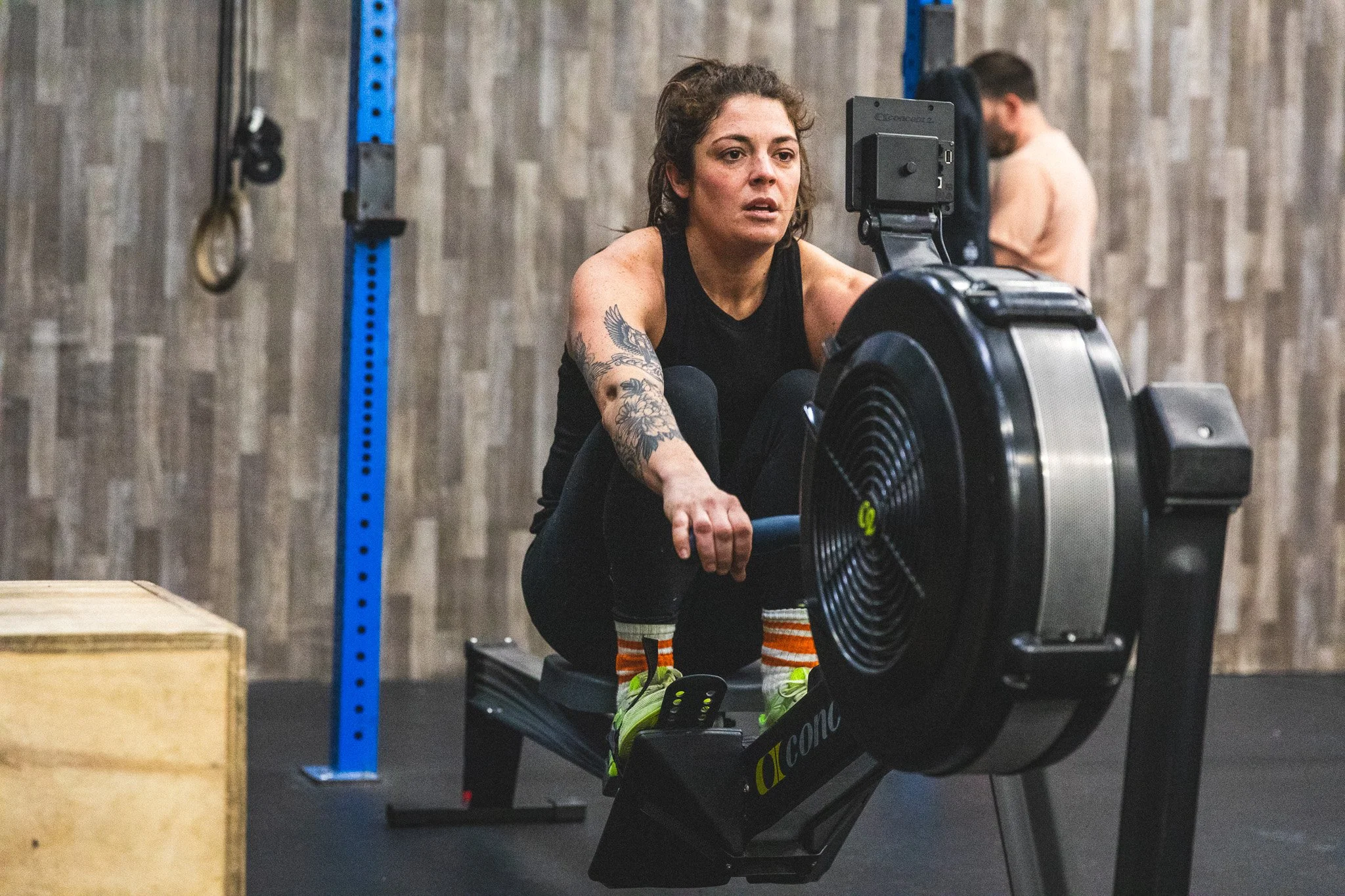
There's a number next to every workout we post. You've probably noticed it.
RPE 9. RPE 7. RPE 6.
If you've ever glossed over it, that's understandable. There's a lot of information inside every workout. But that number might be the most important thing on there — because while the programming tells you what to do, the RPE tells you how hard to do it. And understanding it changes the way you train.
Let's talk about what it means.
The Most Misunderstood Thing About CrossFit
CrossFit has a reputation. You probably already know it: intense. Hard. Not for the faint of heart.
That reputation isn't wrong, exactly (one of our three principles, after all, is "work hard") — but it's incomplete. And the gap between what people think intensity means and what it actually means explains a lot. It explains why some people burn out. Why some programs feel random. Why some members train for years and plateau, while others keep making steady progress for decades.
Intensity is CrossFit's signature. It's also CrossFit's most misunderstood concept.
So let's define it precisely.
What Intensity Actually Means
Most people define intensity by feel — the grunt, the sweat, the "I couldn't walk right for three days" aftermath. That's not actually what intensity means in fitness.
CrossFit's founder Greg Glassman defined it precisely: intensity equals power output — force multiplied by distance, divided by time. In plain English: how much work you do, and how fast you do it. That's it.
This matters because intensity is measurable. It's not a vibe. It's not who yelled the loudest. If you do more rounds of a 15-minute AMRAP this week than you did last month, your intensity went up. Full stop.
And intensity, defined this way, is the ingredient that drives almost every result you're after — better body composition, stronger cardiovascular system, more capable body, improved health markers. As Glassman wrote: "Intensity is the independent variable most commonly associated with maximizing favorable adaptation to exercise."
Understanding this also clarifies something people often get wrong about CrossFit programming: the difference between random and variable. A gym that throws random hard things at you every day isn't CrossFit as much as it's just chaos. On the other hand, a gym that varies movements, time domains, energy pathways, and intentionally modulates intensity across the week? That's variable. That's the point.
The RPE on every workout isn't decoration. It's evidence that the week is designed, not improvised.
So, Why Doesn't Every Workout Go to 100%?
If intensity drives results, the obvious conclusion is: go as hard as possible, every time. That logic works for about six weeks. Then it stops working. Performance drops, injuries show up, dread replaces motivation, and members quietly disappear.
CrossFit coach, athlete, and Seminar Staff member Chris Spealler once put it plainly: "Intensity is being comfortable with being uncomfortable." The key word is comfortable. Not destroyed. Not wrecked. Pushed — but in a way you can sustain.
Going all-out every single time you train creates nervous system and metabolic fatigue. The cure for that fatigue can only be a long period of low-intensity recovery that essentially erases the progress you were trying to make. Three steps back, two steps forward.
The smarter approach: most workouts should sit around 70–85% intensity. An occasional true max effort — maybe two or three times a month. And some days, deliberately easier. The dose makes the poison.
That's the philosophy behind RPE, and why we give it to you every day.
What Does RPE Actually Mean?
RPE stands for Rate of Perceived Exertion. It's a 1–10 scale that describes how hard a given effort should feel. Think of it as the coach telling you not just what to do, but the gear you should be in.
Here's a quick orientation:
RPE 6: Moderately challenging. You're working, but you could hold a conversation. Breathing is elevated, not labored.
RPE 7: Comfortably hard. You're moving with purpose, but the pace is sustainable.
RPE 8: Hard. You're pushing, managing fatigue, but staying in control.
RPE 9: Very hard. Near-maximal effort. You're at your edge — and you know it.
RPE 10: Everything you have. True max effort. Rare, and only appropriate in the right context.
The RPE tells you how hard this specific workout should feel relative to your current capacity. A 6 for an elite athlete looks different than a 6 for someone in their first year of training. That's the point.
We often think “scaling” only relates to the weight on the bar or whether you do sit-ups or toes-to-bar — that’s not where it ends. Just as every movement we do here in the gym can be modified to meet you where you are, the intensity of every workout can also be adjusted to match the RPE target.
What it Looks Like in Real Life
Let's look at a recent week of workouts here at Harpoon, through the RPE lens.
Monday — RPE 8–9
Two-part workout: a hard sprint piece (DB Bench, Double Unders, Farmers Lunge) followed by a 2-mile run. Part 1 was designed to be aggressive — finish before the 8-minute cap. Part 2 was a controlled grind. Two completely different demands in one session. High effort, high skill.
Tuesday — RPE 9
Front Squats and pulling gymnastics (Chest to Bar, Bar Muscle Ups), plus max-effort benchmarks: Pull Ups and Plank. By the numbers, Tuesday was the most demanding day of the week.
Wednesday — RPE 7
An AMRAP with Double Unders, Kettlebell Swings, and Hand Release Push Ups. Challenging, but designed to be repeatable and sustainable across all 5 rounds. Our coaching note said it plainly: stay ahead of fatigue. This is a managed effort day, not a redline day.
Thursday — RPE 6
An EMOM 30 — Goblet Lateral Box Step Overs, Sit Ups, and Bike Calories, with a built-in rest minute every round. Structured rhythm, moderate effort, sustainable output. Recovery is baked right into the format.
Friday — RPE 7
Partner work: 400m runs alternating with an AMRAP of Row, Burpee Box Get Overs, and KB Sumo Deadlifts. Sustained effort, moving well together.
Saturday) — RPE 9
Rope Climbs, Wall Walks, and heavy Cleans. The most skill-dense day of the week and the second genuine high-effort session.
Sunday — RPE 6
An 800m run followed by a 20-minute AMRAP of Lunges, Dumbbell Push Press, and Farmer Carries. Our focus for the day said everything: today is about moving well, not redlining.
To recap: Two days at RPE 9. Two days at RPE 7. Two days at RPE 6. One at RPE 8. That's not random — it's a deliberate wave. High intensity when the programming calls for it. Moderate and lower intensity when recovery and sustainability are the point. The week as a whole produces more adaptation than a week of all-out efforts would, because it allows your body to actually absorb the work.
That's what "constantly varied" means in practice. The variation isn't just in the movements — it's in the intensity. And that intentional variation is what separates a program from a playlist of random workouts.
Where the 3-1-1 Fits In
For those doing the full Active Human Protocol — 3 days at Harpoon, 1 home workout, 1 outdoor activity — the RPE framework extends beyond the gym walls.
Here's the thing: it's genuinely hard to hit high intensity on your own. Whether that's a workout in the garage or a hike up Mount Agamenticus, the social accountability, the coach, the clock on the wall, the person next to you — all of it is gone. And without it, most people naturally settle into a lower gear.
That's not a failure. That's the design.
Your home workout and outdoor activity are, by nature, likely to land in the RPE 5–7 range. A moderate row or kettlebell circuit in the garage. A trail run at a comfortable pace. Time outside, moving through a place you love. That's not wasted effort — it's recovery-compatible training. It's the base layer that makes the hard days at the gym possible without running your system into the ground.
And honestly? Those days are the whole point. We're not here to build people whose lives revolve around the gym. The gym exists to support the life outside it — the ski days, the surf trips, the long weekends on the water, the hikes with your kids that go a little longer than planned. Active people are happy people. The gym is the infrastructure that keeps you active.
The 3-1-1 builds the RPE wave right into the structure of your week. Three coached, intentional days — some hard, some moderate. One day of lower-intensity solo movement. One day of outdoor activity that feels like living. The variety isn't a compromise. It's the whole idea.
Parting Thought
Intensity matters. It's not optional, it's not one ingredient among many — it's the ingredient that drives the results you're here for.
But intensity only delivers when it's dosed correctly. Not every day. Not every workout. The right amount, at the right time, followed by enough recovery to let the adaptation actually happen.
RPE is how we communicate that to you. It's not a vibe check — it's a prescription. When a workout says RPE 7, we mean it. When it says 9, we mean that too.
Pay attention to the number on the board. It's telling you something.
The Sea Legs Program is our four-session private coaching program for anyone new to CrossFit — or anyone who wants to build a real foundation before stepping into a group class. Four sessions. Movement, pacing, strategy. Confidence from day one.
